
Ask ten marketers what GEO is right now and you will get two answers. Some say it is the new SEO. Others say SEO is dead and GEO replaced it.
Both framings miss what is actually happening.
Generative Engine Optimization, or GEO, is the practice of getting your brand cited in ChatGPT, Gemini, Perplexity, Claude, Copilot, and Google AI Overviews. It is not a brand-new discipline. It is SEO adapted for AI-generated answers. And the rebrand turns out to be a good thing, because it is pulling a whole generation of marketers back to fundamentals they had stopped taking seriously.
TL;DR
- The short answer: GEO is just SEO with a rebrand, the practice of getting your brand cited in ChatGPT, Gemini, Perplexity, Claude, Copilot, and Google AI Overviews using the same fundamentals that win in search.
- The spine is identical: Clear claims, accessible pages, useful structure, and verifiable evidence are sound content practices. Different systems can still select different sources.
- What actually changed: A handful of tactics shifted, including the passage as the unit of optimization, new measurement like brand-in-answer rate, brand exposure instead of clicks, and a competitive set that now includes Reddit and forums.
- Why the rebrand helps: Calling it GEO gave SEO a new budget line, forced teams to fix neglected schema and entity models, and separated real practitioners from keyword-tool operators.
- Where to start: Start with technical access, useful content, and measurement. Identify shared SEO work before adding a separate GEO scope; the overlap is not a fixed percentage.
Google’s current guidance for AI features is the primary reference for claims about AI Overviews and AI Mode. It should not be treated as documentation for every other AI platform.
What is generative engine optimization?
Generative engine optimization (GEO) is the process of improving how a brand, website, or piece of content appears in AI-generated answers from systems like Google AI Overviews, ChatGPT, Gemini, Perplexity, Claude, and Copilot. GEO builds on traditional SEO by making content clearer, more authoritative, more structured, and easier for AI systems to understand, summarize, and cite.
In plain English: SEO is about earning visibility in search results. GEO is about earning inclusion, citation, or recommendation inside generated answers. The machine changed. The job did not.
GEO vs SEO: what is actually different?
Most of the work overlaps. The differences are concentrated in surface, format, and measurement.
| Traditional SEO | Generative Engine Optimization | |
|---|---|---|
| Primary surface | Google and Bing search result pages | AI Overviews, ChatGPT, Gemini, Perplexity, Claude, Copilot |
| Goal | Rank a page for a query | Get the brand or page cited inside a generated answer |
| Content format | Page-level optimization for keywords and intent | Passage-level optimization with answer blocks, definitions, comparisons, and FAQs |
| Measurement | Rankings, impressions, clicks, conversions | Brand-in-answer rate, citation share across engines, AI Overview presence, assisted conversions |
| Authority signals | Backlinks, E-E-A-T, topical authority, trust | All of the above, plus entity clarity, sourceable claims, and visibility in retrieval-friendly sources |
| Technical requirements | Crawlability, indexation, speed, schema, internal linking | Same foundation, plus structured data tied to visible content and clear entity signals |
| User behavior | User clicks a link to your page | User reads an AI answer that may or may not click through |
| Success metric | Organic traffic and conversions | Cited inclusion and brand exposure inside the answer, plus the traffic that still flows |
The headline reads: SEO is about earning visibility in search results. GEO is about earning inclusion, citation, or recommendation in generated answers. Same craft. Different surface.
How SEO lost the plot
For the last decade, “SEO” got watered down to mean one of three things, depending on who you asked:
- Keyword stuffing and link schemes, from people who never actually did SEO.
- A technical checklist somebody ran once in 2019.
- Writing 2,000-word blog posts targeting a keyword nobody searches.
Real SEO, the discipline of making your content legible, trustworthy, and citable to a machine that is trying to answer a user’s question, never stopped working. It just got boring to talk about. So the conversation moved on to growth hacks, paid social, “content marketing” divorced from search intent, and a dozen other things that felt newer.
Then ChatGPT hit the search market. Then AI Overviews started eating click-throughs. Suddenly there was a whole new layer of discovery that ran on structured content, clean architecture, and authority signals. Which is to say, it ran on SEO.
GEO is what we are calling it because “SEO” had lost its seat at the strategy table. The rebrand got it back.
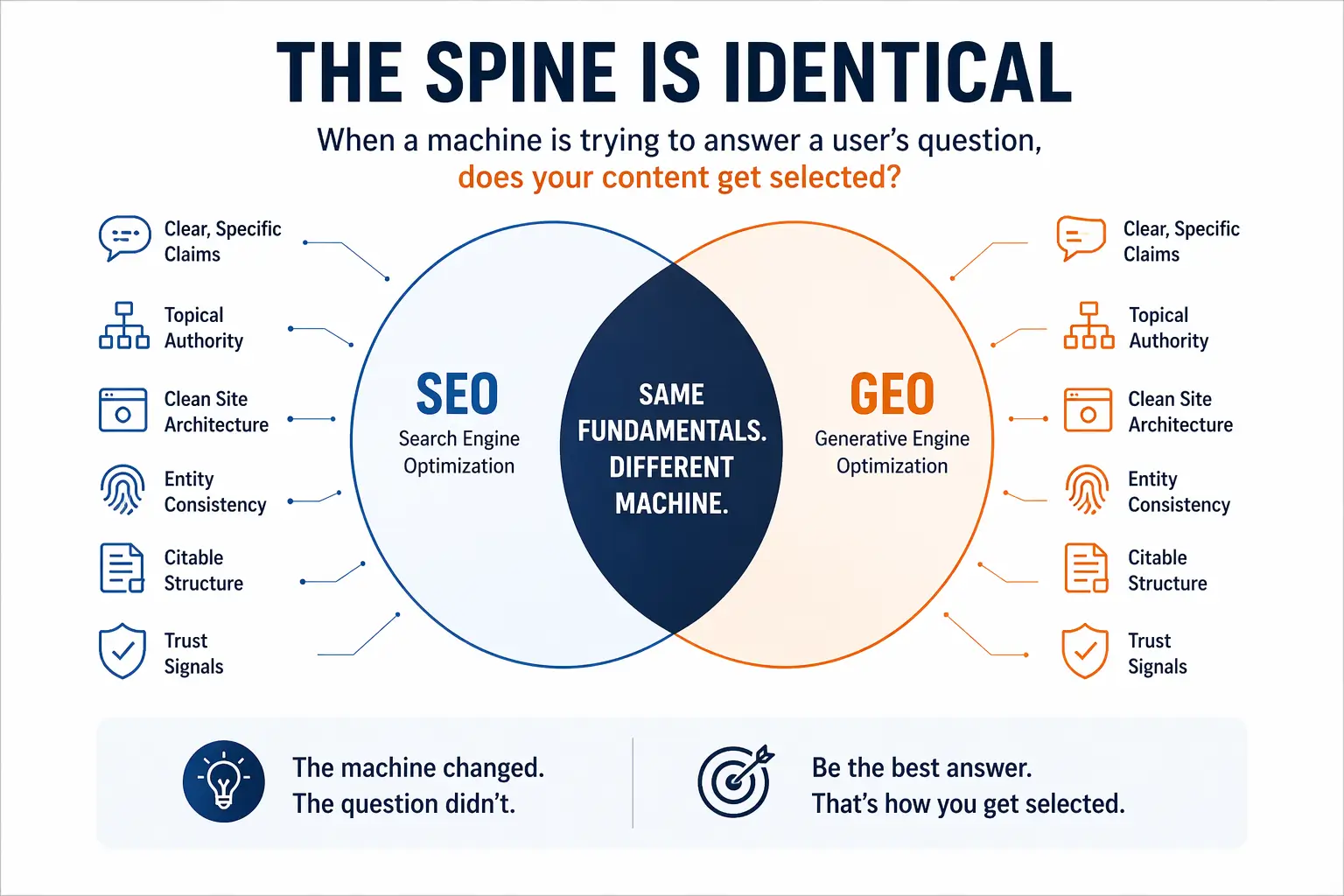
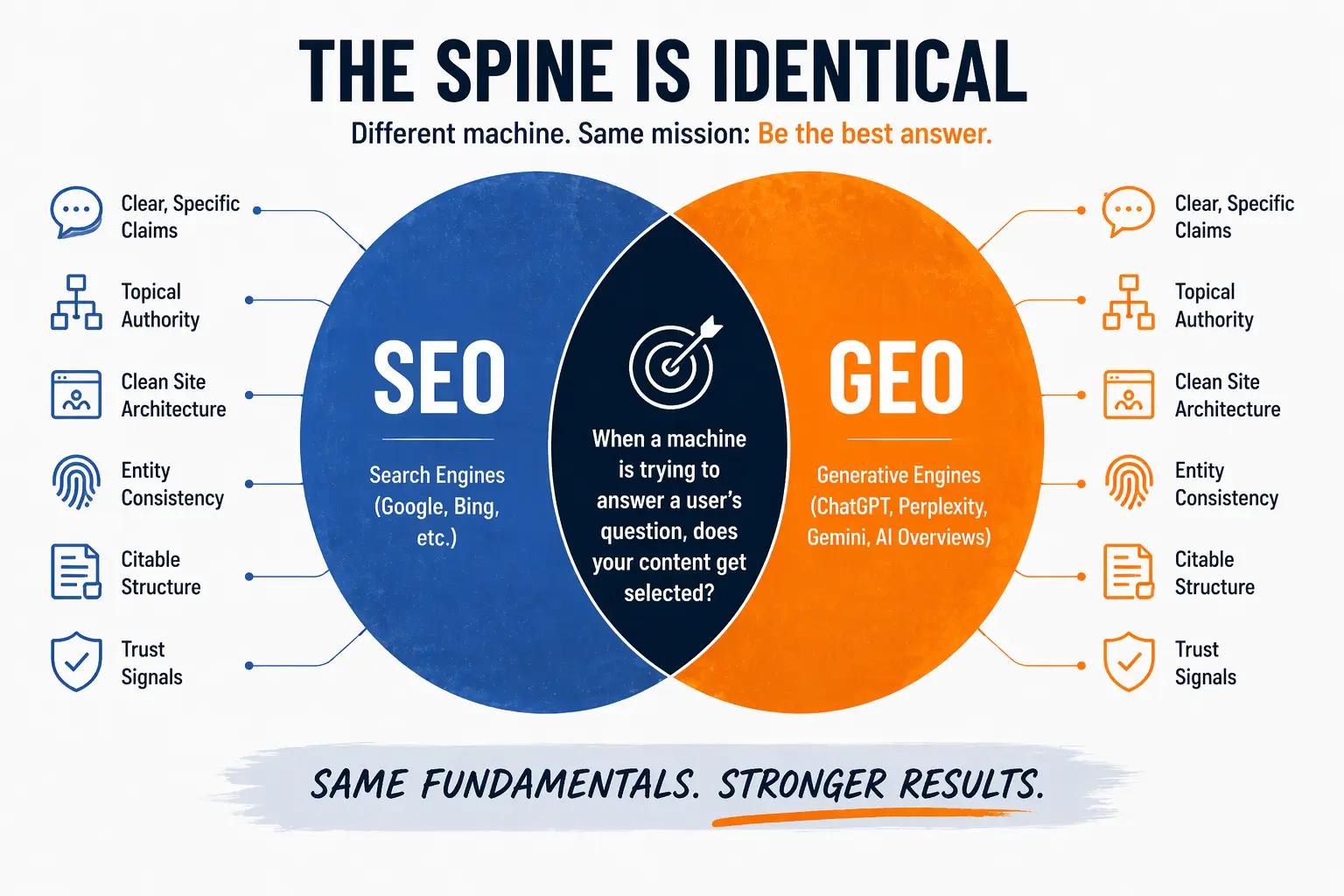
The spine is identical
When I say GEO is SEO, here is what I mean specifically.
Both disciplines ask the same question: when a machine is trying to answer a user’s question, does your content get selected?
I review these fundamentals in both SEO and AI search work, without assuming the systems weight them equally:
- Clear, specific claims over vague marketing language.
- Topical authority on the subject. Not just a single page, but a cluster of related content that signals you actually know the thing.
- Clean site architecture that helps crawlers, and now retrieval systems, understand how information is organized.
- Entity consistency, meaning your brand, your product names, and your core concepts used the same way across every surface.
- Citable structure: headings, lists, tables, schema, and direct answers that can be extracted.
- Trust signals: author credentials, named sources, real data, and third-party validation.
Read that list again. Every item on it has been SEO best practice since roughly 2015. Schema? Same. E-E-A-T? Same. Answer-the-question content? Same. Entity-based optimization? Same.
What changed is which machine is doing the reading. That changes a handful of tactics, not the spine.
What did not change
These are the SEO fundamentals that AI search did not retire. If anything, AI search made them count more.
- Crawlability still matters.
- Indexation still matters.
- Content quality still matters.
- Authority still matters.
- Internal linking still matters.
- Technical SEO still matters.
- Clear topical focus still matters.
- Backlinks still matter.
- Author and entity signals still matter.
If your fundamentals are weak, no amount of “GEO strategy” saves you. The retrieval pipelines that feed AI answers pull from the same open web. They reward the same things.
What did change
A handful of things genuinely shifted, and ignoring them is how teams get burned.
The presentation of evidence. Retrieval-based systems may use relevant passages from a page, but there is no universal two-to-three-sentence citation rule. Write sections that answer a real question and retain enough context to be understood on their own. Verify how the platforms in your sample actually cite the page.
The measurement. You cannot rank-track your way to GEO visibility. Ranking #1 in Google does not mean you get cited by ChatGPT, and vice versa. You now need to measure brand-in-answer rate, citation share across engines, and AI Overview presence alongside classic rankings. The tools are immature, and most teams are still flying blind.
The distribution. A cited answer in ChatGPT does not send you a click the way a Google result does. You get brand exposure instead of traffic. That is a real trade-off, and it changes how you value the work. It does not change how you do the work.
The competitive set. In a lot of categories, the pages getting cited by LLMs are not the pages ranking in Google. Reddit, niche forums, and heavily-structured reference sites are over-indexed in LLM training and retrieval. If you are a B2B brand, you may suddenly be competing with a Reddit thread from 2022. That is a strategy problem worth thinking about carefully.
Brand mentions matter more than URLs. AI engines diverge widely on which URLs they cite, but they converge on which brands they name. The brand is the unit that travels across engines. The URL is incidental.
Content has to answer the next question, not just the first query. AI tools follow up. Your content needs to anticipate the comparison, the alternative, the objection, and the “is it worth it” question that comes after the initial answer.
These are real changes. But notice what they do not change: the underlying craft.
Is GEO the same as answer engine optimization?
GEO and AEO overlap, but the terms are not used identically across the industry.
- Answer engine optimization (AEO) usually focuses on earning concise answers in search features, voice assistants, and answer engines. Featured snippets, voice queries, and Perplexity-style direct answers are the core surface.
- Generative engine optimization (GEO) is the broader umbrella. It covers how brands and content appear in AI-generated summaries, recommendations, comparisons, and citations across the major LLM-powered surfaces.
- AI search optimization and LLM SEO are working synonyms many practitioners use interchangeably with GEO. You will see all four terms in the same job descriptions and agency pitches.
- AI Overview optimization and Google AI Overview SEO are the narrow, Google-specific subset, focused on getting cited inside Google’s generated SERP overviews.
The acronym fight is not the work. The work is making your brand clear, credible, and quotable across every surface a buyer might use to ask about your category.
How generative engine optimization works
Strip away the marketing and GEO is a six-step practical system. None of it is exotic. All of it is hard if you have not been doing it.
- Define the entity. Who you are, what you do, who you help, what problems you solve. One consistent story across the site, schema, and the open web.
- Build topical authority. Service pages, explainers, FAQs, comparisons, alternatives, and case studies that cover the subject from every angle a buyer cares about.
- Structure content clearly. Definitions, summaries, tables, lists, and direct-answer paragraphs. Schema that matches the visible content. Self-contained sections an LLM can extract.
- Strengthen authority. Credible authorship with bios, real expertise, named sources, third-party mentions, and the backlinks that reflect the work being cited elsewhere.
- Improve technical access. Crawlability, indexation, speed, structured data, and internal linking that helps both Googlebot and retrieval systems understand the site.
- Measure visibility. Track rankings and clicks, but also brand-in-answer rate, citation share across engines, AI Overview presence, and assisted conversions. The metric stack is bigger now.
Done together, these earn rankings in Google and citations in AI engines from the same content investment. There is no trade-off.
How to do GEO without chasing gimmicks
There is a small industry forming around “GEO hacks”. Most of them are noise. The boring checklist below outperforms the hacks every time.
- Start with SEO fundamentals. If they are broken, fix those first.
- Rewrite vague service pages into clear, answer-ready pages.
- Add FAQs and direct answer blocks under your H2s.
- Build comparison content, “what is” explainers, and alternative pages for your category.
- Make author expertise visible. Real bios, real credentials, real opinions.
- Use schema where it matches visible content. Article, FAQ, HowTo, Organization, Product, Service.
- Link related pages into topical clusters so the entity model is obvious.
- Track AI mentions manually until the tools mature. Run 30 to 50 high-intent prompts across ChatGPT, Gemini, Perplexity, Claude, and AI Overviews. Note where you show up and where you do not.
If that list looks suspiciously like an SEO checklist with a few additions, that is the point.
Where your current SEO program probably falls short
If you are an executive trying to pressure-test your team’s readiness for AI search, here is where most programs are weakest right now:
- Too much content is written for keywords, not questions. AI search is question-shaped. Pages that target a noun phrase without ever answering a real question get ignored.
- Service pages are vague. They describe a category instead of explaining what you actually do, who you do it for, and why a buyer should trust you.
- Brands fail to explain themselves. The “About” page is fluffy. The category positioning is implied, not stated. AI systems cannot summarize what is not on the page.
- Thought leadership lacks answer-ready structure. Smart essays with no H2s, no direct answers, and no self-contained passages are harder for retrieval systems to interpret and cite, no matter how good the writing is. Structure improves extractability; it is not a guarantee of visibility.
- Teams measure only traffic, not visibility. If your dashboard does not show citation share or AI mentions, you are flying blind on half the discovery layer.
Fix these and your SEO program improves. Your AI search visibility improves. Same work. Two outcomes.
Why the rebrand is actually helpful
If the fundamentals are the same, why does the rebrand matter at all? A few reasons. They are the reasons a lot of SEO veterans are quietly grateful for it.
It gave SEO a new budget line. “We need to fund SEO” has been a hard sell in a lot of orgs. “We need to be visible in ChatGPT” is an easy one. The work can share technical and content resources, but the amount of overlap depends on the scope.
It forced teams to fix things they had been ignoring. Schema that was half-implemented. Entity models that did not exist. Author attribution missing from thousands of pages. Internal linking that had gotten sloppy. All of this tends to get fixed when someone senior starts asking why the company is not cited in AI answers.
It separated the real practitioners from the posturers. A lot of people who called themselves SEO experts were really just keyword-tool operators, and they are out of their depth in GEO. The people who understood the fundamentals (how search engines actually evaluate content, how entities and authority work, how to write for machines and humans at the same time) have an edge again. If you have been watching SEO evolve through twenty years of algorithm shifts, this one rhymes with the others. New surface. Same craft.
Where to start
If you are trying to figure out what to do about any of this, the honest answer is: start with the fundamentals, because the fundamentals are the work.
An AI Search Visibility & SEO Strategy engagement should name which work is already covered by SEO and which measurement or source-review tasks are additional. Review the deliverables rather than applying a fixed percentage to the whole program.
If your schema is broken, fix it. If your author bios are thin, flesh them out. If your content is full of vague marketing language, rewrite it in specific, verifiable claims. If your topical clusters have holes, fill them with a stronger content strategy built for AI search. All of it helps you rank in Google and get cited by ChatGPT. There is no trade-off.
The teams doing well in GEO right now are not the ones who threw out their SEO playbook. They are the ones who finally executed on it.
The takeaway
GEO is SEO with a rebrand. The rebrand is useful because it is pulling attention and budget back to a discipline that got unfairly dismissed. The tactics that win in AI search are the same tactics that have always won in search: clarity, specificity, authority, structure, trust.
If you have been doing SEO right, you are already doing most of GEO.
If you have not, the good news is you now have an excuse to start. The bad news is your competitors are using the same excuse.
Frequently asked questions
What is generative engine optimization?
Generative engine optimization (GEO) is the practice of improving how a brand, website, or piece of content appears in AI-generated answers from systems like Google AI Overviews, ChatGPT, Gemini, Perplexity, Claude, and Copilot. It builds on traditional SEO by making content clearer, more structured, more authoritative, and easier for AI systems to understand, summarize, and cite.
Is GEO replacing SEO?
No. GEO is an extension of SEO, not a replacement. The retrieval pipelines that feed AI answers pull from the same open web, so traditional SEO fundamentals like crawlability, content quality, internal linking, authority, and structured data still drive AI search visibility. GEO adds a layer on top: passage-level extractability, entity clarity, and answer-engine measurement.
What is the difference between GEO and SEO?
SEO focuses on ranking pages in traditional search results like Google and Bing. GEO focuses on getting brands and content cited inside AI-generated answers from Google AI Overviews, ChatGPT, Gemini, Perplexity, Claude, and Copilot. SEO measures rankings and clicks. GEO measures brand-in-answer rate, citation share, and AI Overview presence alongside the traditional metrics.
Is GEO the same as answer engine optimization?
GEO and answer engine optimization (AEO) overlap heavily but are not identical. AEO usually focuses on concise answers in search features, voice assistants, and answer engines like Perplexity. GEO is broader, covering how brands and content appear in AI-generated summaries, recommendations, comparisons, and citations across all major LLM-powered surfaces. Many practitioners use GEO, AEO, AI search optimization, and LLM SEO interchangeably.
How do you optimize content for AI search engines?
Optimize content for AI search by combining traditional SEO with passage-level structure. Front-load direct answers under each H2, write self-contained sections an LLM can extract, define your entity clearly, build topic clusters that demonstrate authority, use schema that matches visible content, and include comparisons, FAQs, and definitions. Strong technical SEO and strong topical authority remain non-negotiable.
Can GEO help with Google AI Overviews?
Google says its established SEO guidance applies to AI Overviews and AI Mode. Pages need to be indexed and eligible for a search snippet, and inclusion is not guaranteed. There is no special schema or AI text file required.
How do you measure generative engine optimization?
Measure GEO with a metric stack, not a single number. Track brand-in-answer rate by running a fixed set of high-intent prompts across ChatGPT, Gemini, Perplexity, Claude, and Google AI Overviews. Add citation share across engines, AI Overview presence on priority queries, structured-data coverage on money pages, and assisted conversions from referrer-light AI traffic. Keep traditional rankings and clicks in the dashboard. Both still matter.
Do small businesses need GEO?
Yes, especially in categories where buyers are already using AI to research vendors. The good news is the work is mostly traditional SEO done well: clear service pages, real expertise on the page, FAQs that answer real buyer questions, structured data, and internal linking. A small business that nails the fundamentals often outperforms larger competitors who treated SEO as an afterthought.
If you want a read on where your brand stands in both Google and the AI engines, see my AI Search Visibility & SEO Strategy service or Book a free 30-minute call. No pitch, no pressure.