
You tell the AI: “Find me three vendors for our new payroll software, compare them on pricing and integrations, and schedule a demo with the best one.”
Twenty minutes later, it’s done. It searched. It read the pricing pages. It cross-referenced your current tech stack. It picked one and booked the call on your calendar.
You didn’t click anything. You didn’t review a shortlist. You didn’t ask a follow-up. That’s agentic AI in practice: a system that acts on a goal without waiting for your next prompt. Six months ago, the same workflow would have taken an employee an afternoon.
Who is accountable for those decisions?
That question, not “which AI tool should I buy,” is the one that will determine whether agentic AI helps your business or quietly creates problems you won’t find until they’re expensive.
TL;DR
- The real first question: The question that determines whether agentic AI helps your business is “who is accountable when the agent gets it wrong,” not “which AI tool should I buy.”
- What agentic AI is: Agentic AI is a system that pursues a goal autonomously by breaking it into steps, taking actions across tools, and looping until the task is done, without waiting for your next prompt.
- Where it is ready today: Agents work well right now for research, first-draft content, customer inquiry triage, internal knowledge retrieval, and meeting notes, where the cost of error is low.
- The accountability gap: Agents compress the chain of decisions, so several judgment calls happen on your behalf before you see the output and without a clear paper trail.
- The actual advantage: The businesses that win build a human handoff map, a documented list of every point where a person must review or approve before the next step runs, before any agent goes live.
What agentic AI actually means
Agentic AI is an AI system that can pursue a goal autonomously: it breaks the goal into steps, takes actions across tools and systems, checks its own work, and loops until the task is done. It is distinct from standard AI assistants, which respond to one prompt at a time and require human direction at every step.
Most AI tools you’ve used are reactive. You ask something, they answer. You paste something in, they summarize it. The value is real, but the interaction model is the same as a search engine: you pull, it responds.
A useful comparison: a standard AI tool is a very smart calculator. An AI agent is a fast contractor who can read email, fill out forms, browse the web, update a spreadsheet, and draft a response, all from a single instruction.
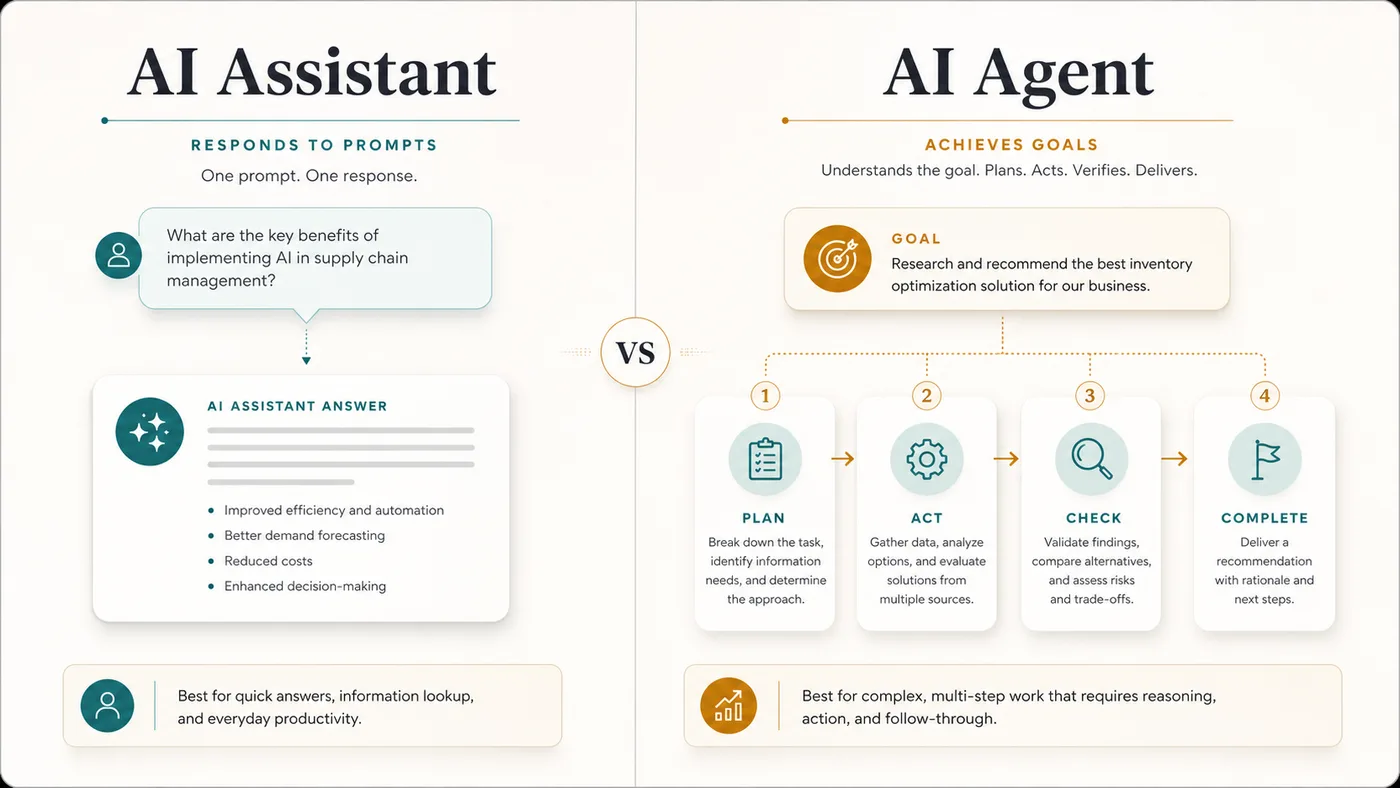
When a tool answers a question, you evaluate the answer and decide what to do. When an agent completes a task, decisions have already been made on your behalf. The sequencing of who does what has changed, and that changes how you need to manage it.
AI agents running in browsers already research vendors, compare options, and take action without a human reviewing each step. Microsoft has rolled out Copilot agent mode in Word, Excel, and PowerPoint. Salesforce launched Agentforce for sales and service workflows. The agent layer isn’t coming. It’s here, available on plans your team is already paying for.
The three questions every business owner gets wrong
McKinsey’s 2026 survey, published August 25, reports that nearly nine in ten respondents’ organizations regularly use AI in at least one business function. Forty percent of respondents from large organizations report scaling agents, compared with 22 percent from smaller organizations. These measures cover AI use and agent scaling, not the same generative-AI adoption metric reported in 2024.
When business owners engage seriously with agentic AI, they tend to cluster around three questions. All three are worth asking. None of them is the right first question.
| What owners ask | What they should ask instead |
|---|---|
| ”Which AI tool should I buy?" | "Which decisions am I comfortable delegating?" |
| "Will it replace my team?" | "What does my team do when the agent handles the routine work?" |
| "Is it accurate enough?" | "What are the consequences of a mistake made at agent speed?” |
“Which AI tool should I buy?” is a purchasing question dressed up as a strategy question. Tools matter, but the more important work is defining scope before you pick anything. An agent is only as useful as the clarity of the boundary you set around it. If you can’t answer “which decisions can this agent make without a human review,” you’re not ready to deploy one, regardless of which vendor you choose.
“Will it replace my team?” misframes the actual shift. Agents are most useful for the parts of a job that are high volume and rule based: research, scheduling, data entry, inquiry routing. That frees your team to handle the parts that require judgment, relationships, and accountability. But figuring out what that redistribution looks like in practice is work the business owner has to do before the agent is live, not while cleaning up afterward.
“Is it accurate enough?” is the right instinct applied to the wrong frame. Agents don’t just produce outputs you can check. They take actions. An agent that misreads a pricing table might book the wrong vendor, send the wrong number to a client, or route a customer somewhere they shouldn’t be. Speed amplifies the cost of being wrong. The question isn’t whether the agent will make mistakes. It’s whether your business is set up to catch them before they compound.
The accountability gap
When your team makes a decision, accountability is traceable. Someone chose this vendor. Someone approved this quote. Someone sent this email. If something goes wrong, you can find the who and the why.
Agents compress that chain. A single instruction triggers a sequence of decisions. By the time you see the output, several judgment calls have already happened on your behalf, quickly, and without a paper trail that maps naturally to how your business assigns responsibility.
The answer isn’t to avoid agents. Scope them carefully before they go live.
You wouldn’t hire a new employee and immediately give them purchasing authority, client facing communication rights, and access to your calendar, all unsupervised, on day one. Agents need the same kind of guardrails: client communications held for review before they send, contracts flagged before they’re initiated, expenses over a certain threshold approved by a person.
The businesses that get this right will build what I’d call a human handoff map: a documented list of every point in an agent-driven workflow where a person must check or approve before the next step runs. It defines the boundaries of agent autonomy in your business. It doesn’t have to be complex. It just has to exist before you deploy.
Where agentic AI is actually ready for business today
The hype around agentic AI swings between “it will do everything” and “it’s not ready for anything.” Neither is useful for making a real decision about your business.
Here’s what’s genuinely working for small and mid-size businesses right now:
-
Research and summarization. Competitive monitoring, market research, prospect research before a sales call. Agents synthesize large amounts of information faster than any person and surface what’s relevant. You still evaluate the output. The agent gets you there in minutes instead of hours.
-
First-draft content. Blog posts, proposals, outreach sequences, internal documentation. Agents handle the blank-page problem well. A human reviews before anything goes out.
-
Customer inquiry triage. Categorizing and routing inbound messages by type or urgency so your team focuses on what needs them. The agent sorts, the person responds.
-
Internal knowledge retrieval. Answering questions against your documentation or SOPs. Useful for onboarding and support, especially when information is scattered across a shared drive nobody has time to organize.
-
Meeting notes. Transcribing and generating action items from calls. Low consequence if imperfect, real time saved if it works.
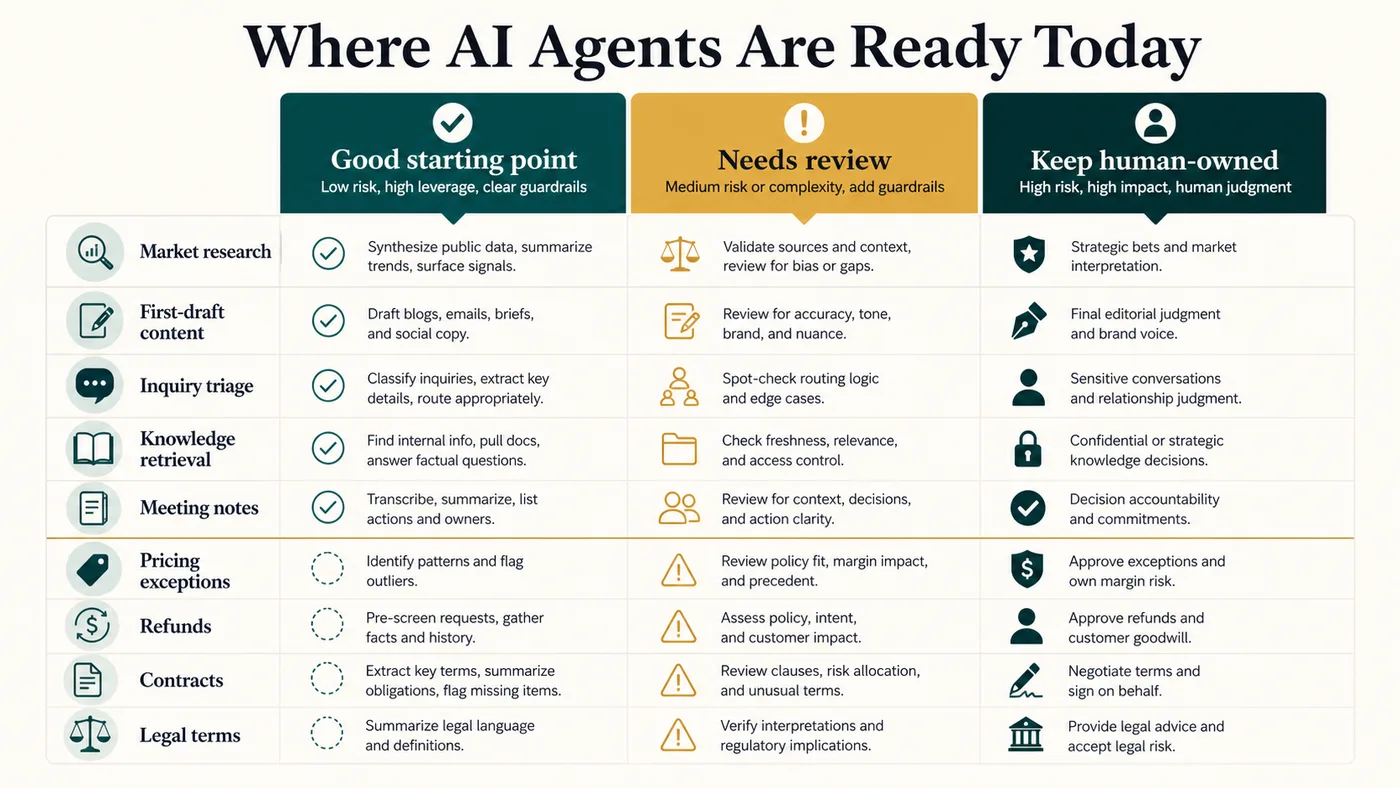
One category to treat carefully: autonomous decisions with financial or legal consequences. Contract terms, refund approvals, pricing exceptions, anything a dissatisfied customer could escalate. Agent errors here create real liability. Keep a person in the loop until you have enough data on your specific setup to make a reasoned call about loosening that constraint.
Common questions about agentic AI for business
What is agentic AI? Agentic AI is an AI system that pursues a goal autonomously: it breaks the goal into steps, takes actions across tools and software, and iterates until the task is complete. Unlike a chatbot, it doesn’t wait for a prompt at each step.
How is agentic AI different from regular AI tools like ChatGPT? Standard AI tools respond to one prompt at a time. You direct every step. An AI agent receives a goal and figures out how to achieve it: searching, writing, booking, routing, updating. The human sets the goal; the agent handles the execution.
Is agentic AI safe to use in business operations? For well-scoped, reversible tasks: yes. Research, drafting, triage, and note-taking are low-risk starting points. Decisions with financial, legal, or customer-facing consequences need human review until you have real data on your agent’s accuracy. The risk isn’t that agents are unreliable. It’s that errors happen fast, without a visible trail.
What business tasks are best suited for AI agents? High-volume, rule-based tasks with low cost of error: market research, first-draft content, inquiry triage, knowledge retrieval, meeting summaries. Tasks that require judgment, relationship context, or financial authority should stay with humans, at least initially.
How do I decide which decisions to delegate to an AI agent? A useful test: would you let a capable contractor you’d just hired make this decision unsupervised on day one? If yes, it’s a candidate for agent delegation. If no, define what oversight you’d want first, then build that into the workflow.
What is a human handoff map? A human handoff map is a documented list of every point in an agent-driven workflow where a person must review or approve before the next step runs. It defines where agent autonomy ends. If you don’t have one before deploying, you’re relying on the agent to stay inside boundaries you haven’t actually set.
The governance layer is the actual advantage
Most business owners are either waiting to see what happens or deploying agents as fast as possible with the accountability questions set aside for later. Both are understandable. Neither works.
The businesses that come out ahead are the ones doing unglamorous work right now: deciding what the agent can handle, deciding where humans stay in the loop, and building a review habit before agent outputs are trusted enough that nobody is reviewing them anymore.
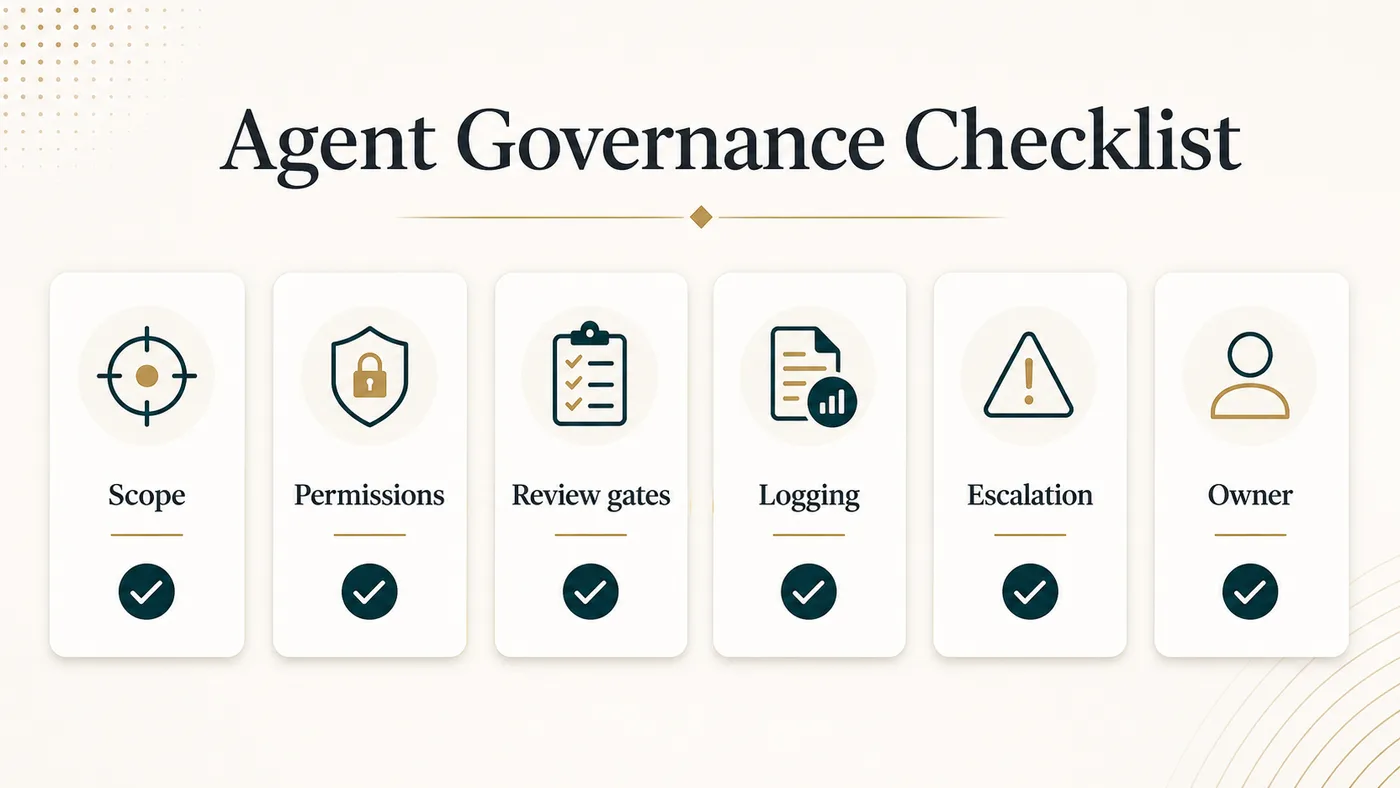
That’s not a sexy strategy. It doesn’t make for a good announcement. But it’s the difference between a business that accelerates with agents and one that spends Q3 untangling what they did in Q1.
The question isn’t whether agentic AI is coming for your industry. It is. The question is whether your business has a clear answer to “who is accountable when the agent gets it wrong” before the first one does.
If you’re working through where agents fit in your business and want a clear-eyed read on the opportunity and the risk, Book a free 30-minute call. No pitch, no pressure. If you’re ready to start building, see my AI Workflow Automation service for how I design, implement, and govern agent workflows end-to-end. Or, if you want to understand how agents are already changing what buyers see about your brand before they reach your site, read about agents and brand visibility.